


Fine patterns, not loud statements
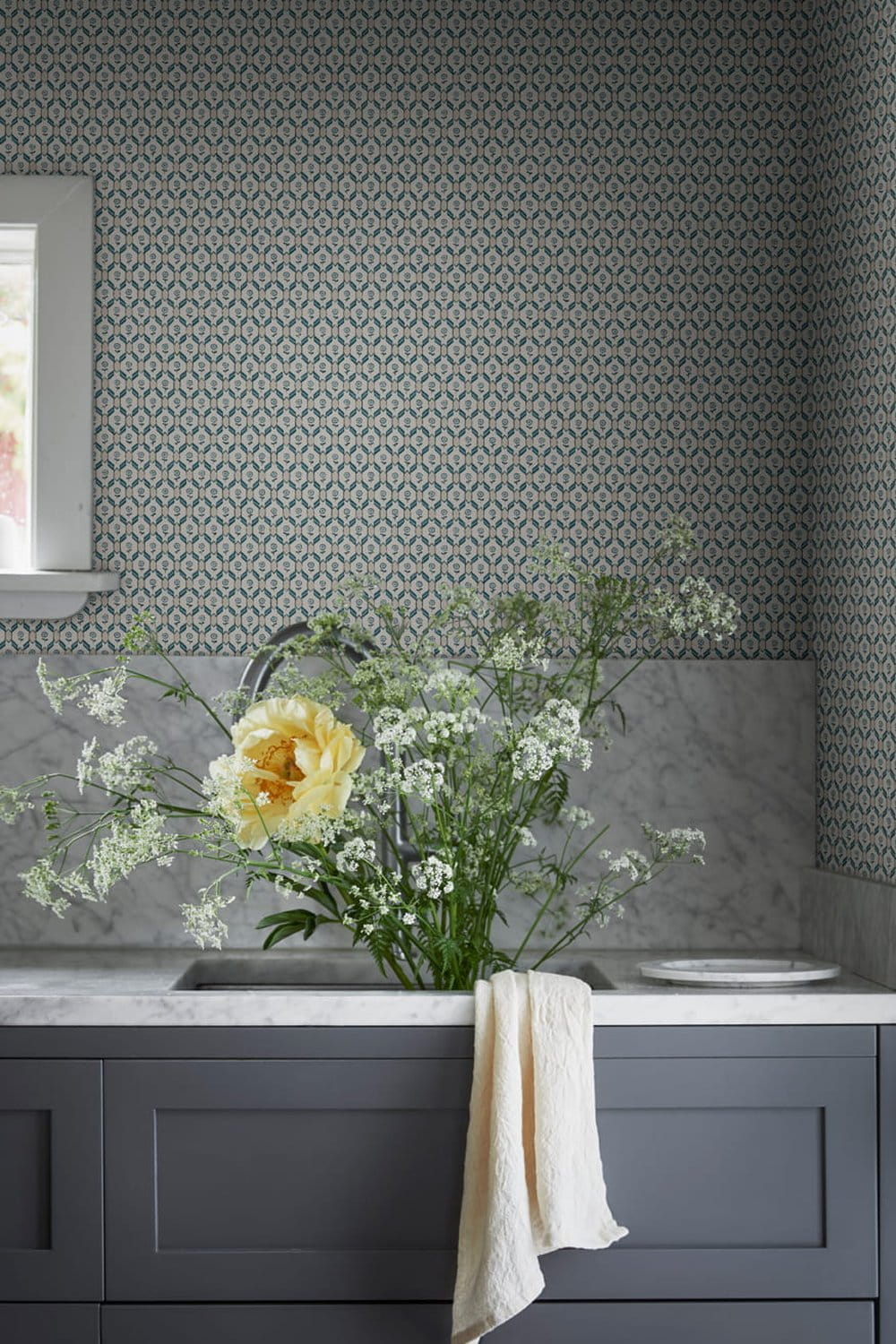
That wallpaper has no place in a small room is, in my view, one of the misconceptions of interior design. What matters is scale. Large motifs in strong colours bring the wall forward and make the room shrink. Fine lines, small repeats and muted contrasts, by contrast, give the surface structure without dominating it: from just a few steps away, they resolve into a lively texture.
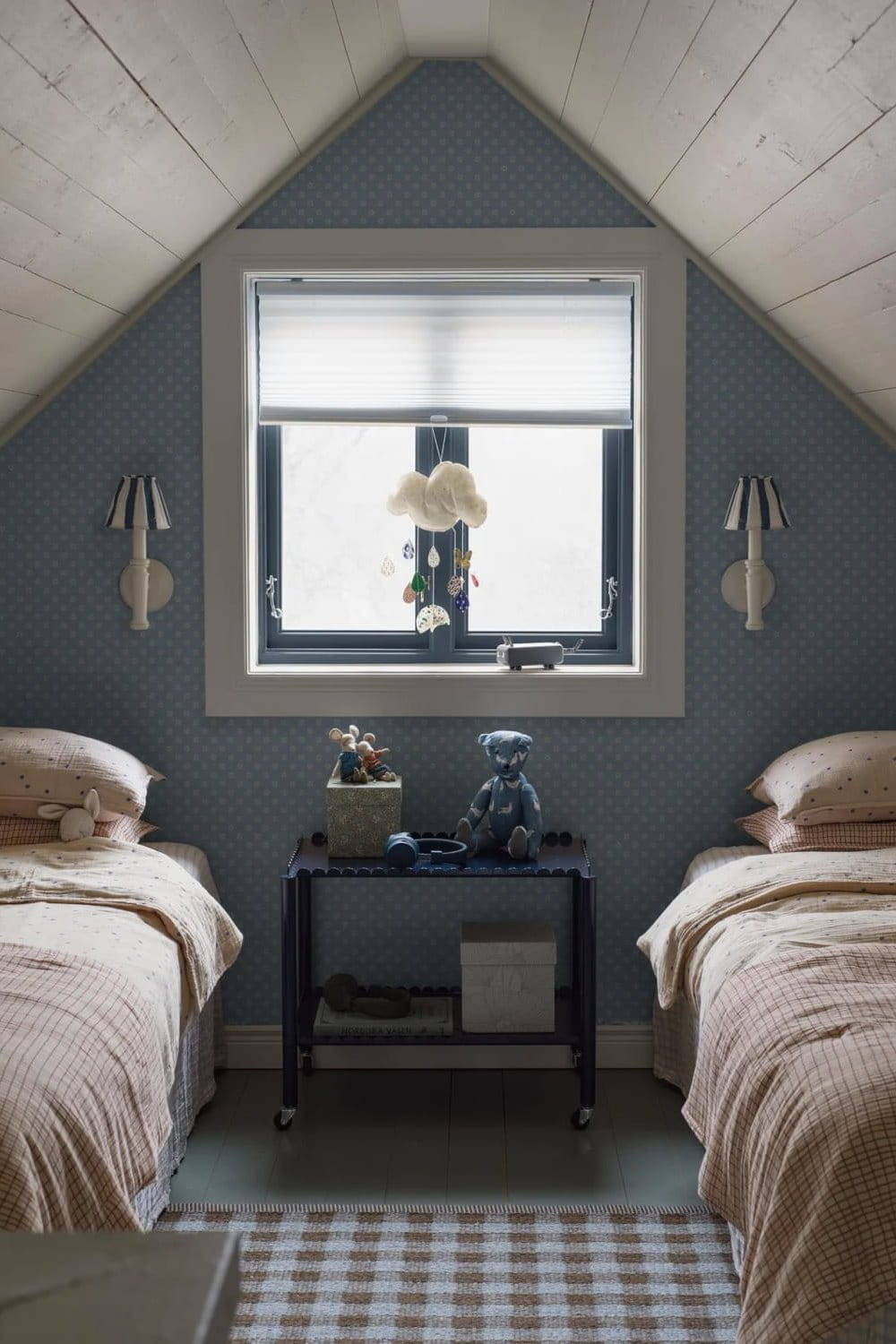
Few practise this discipline with as much assurance as the traditional Swedish houses Sandberg and Boråstapeter. Mollys Meadow by Boråstapeter traces delicate grasses tone on tone. Hugo by Sandberg draws on a historic domino paper, a precursor of wallpaper, setting stylised flowers in a geometric repeat of just 4.4 cm. Skogsstjärna, from the Boråstapeter archive, scatters small star-shaped flowers across the wall in an airy rhythm.



Well-placed accents
A love of expressive patterns need not be sacrificed in small rooms. What matters is where they are placed: on a single wall behind the bed or sofa, in an alcove, in the hallway. The eye is guided with intent, the remaining walls stay calm, and the room loses nothing of its sense of space.
A classic for this approach is a wallpaper such as Hippo by Studio Lisa Bengtsson. Its stacked hippos in muted grey and cream lend the wall a touch of humour and character. With a 64 cm repeat, the design only shows its full effect on an uninterrupted surface; it is less suited to walls broken up by corners or to window recesses.


Light shades for a sense of space
Few things shape the perception of a room as strongly as its colour. White, cream, sand and softened pastels reflect light and make walls visually recede; rooms with little daylight in particular gain an airy lightness.
Dark shades are not off limits, but they call for a counterweight in light furniture, textiles or a pale ceiling. A deep blue wall with a fine gold pattern can then give a small room a surprising degree of elegance and intimacy.
Those who want a light, Scandinavian feel will find it in Northern Stone by Boråstapeter, whose finely detailed stone texture radiates calm and naturalness, and in Rob Leaves by Coordonné: small leaves executed in watercolour technique, matt and coloured with a gentle warmth in the Dune colourway.


Stripes with impact
Vertical stripes draw a room upwards, a proven device for low ceilings. Run horizontally, they make narrow rooms appear wider. Tone-on-tone versions are particularly elegant, guiding the eye without claiming it.
Swedish makers such as Boråstapeter offer a wide range of striped wallpapers. Falsterbo, for instance, recedes into the background with its delicate block stripes, yet gives the room a clear structure. A special printing technique also lends the matt non-woven wallpaper a slightly tactile, traditional feel.


Texture and sheen for depth
Fine embossing and a subtle sheen create a play of light and shadow that gives a room depth and elegance. It is at its most beautiful in raking daylight or beneath a wall light whose glow grazes the surface and gently brings out its texture.
The Belgian brand Arte has mastered this play: in Facet, irregular polygons on a textured vinyl surface create a relief effect that shifts with every change of light.


Depth through perspective
Panoramic wallpapers with a sense of distance, be it a landscape, a path or architecture with a vanishing point, visually open up small rooms. The motif must not feel overloaded, and its palette should sit comfortably within the room's scheme.
A fine example is Vallée du Rift by Isidore Leroy. Illustrator Francesco Battista drew the plains of the Rift plateau, with giraffes, birds and acacias, in fine dots. In the Naturel colourway the motif remains light and graphic, and since it can be extended panel by panel, it adapts to narrower walls too.


In practice: repeat, samples and light
In small rooms, scale counts twice. A small-scale design such as Skogsstjärna (3.78 cm repeat, straight match) reads as a fine texture from a distance and is forgiving of sloping ceilings, window reveals and short stretches of wall. Larger designs such as Hippo (64 cm repeat) need an uninterrupted surface to unfold and produce more waste when cutting. Our wallpaper calculator tells you how many rolls you will need.
Before deciding, it is worth ordering a wallpaper sample and viewing it on the wall at different times of day: north light cools colours, while warm artificial light in the evening alters them once more.
My conclusion
In many of my projects, one thing becomes clear: with the right wallpaper, small rooms not only look larger, they also gain character. Whether light colours, delicate patterns, textured surfaces or a well-placed focal point, each of these approaches gives a room a sense of space, without adding a single square metre.